




NXP Semiconductors MCXW236BUK-RDM Radio Module Board

NXP Semiconductors MCXW236BUK-RDM Radio Module Board is a highly configurable, low-power, and cost-effective evaluation and development board for prototyping and demonstrating the MCXW236BUK device. The NXP Semiconductors MCXW236BUK is a highly integrated, single-chip ultra-low-power BLUETOOTH® Low Energy 5.3 wireless transceiver with embedded microcontroller and flash, targeted for Internet of Things (IoT) applications.
Features
- Connectivity
- NXP's ultra-low-power MCXW236BUK Wireless microcontroller unit (MCU) supporting Bluetooth LE
- Fully compliant with Bluetooth 5.3 LE
- Reference design with a small-footprint, low-cost RF node
- Single-ended input/output port
- Low count of external components
- Maximum output power can reach up to +6dBm at the SubMiniature version A (SMA) connector
- Selectable power source
- Configuration is done through solder jumpers
- DC-DC converter
- MCXW236BUK with buck capability for operation on the 3.0V battery
- 32MHz reference oscillator for radio frequency (RF) operation
- 32.768kHz reference oscillator used for low-power operation
- Flexible RF transmitter level configuration
- TX Mode 1 (TXM1) - range from -31dBm to +2dBm when VDD_RF exceeds 1.1V (default-configured mode)
- X Mode 2 (TXM2) - range from -28dBm to +6dBm when VDD_RF exceeds 1.7V
- Packaging
- Printed circuit board (PCB) marking of MCXW236BUK-RDM
- A 4-layer PCB with micro and blind vias
- PCB color is blue
Applications
- Industrial
- Continuous Glucose Monitoring (CGM)
- Home control panels
- Respiratory care
- Smart inhalers
- Smart lighting
- Smart locks
- Vital signs monitors
- Consumer
- Companion chip for UWB tracking tags and localization applications
- Window coverings
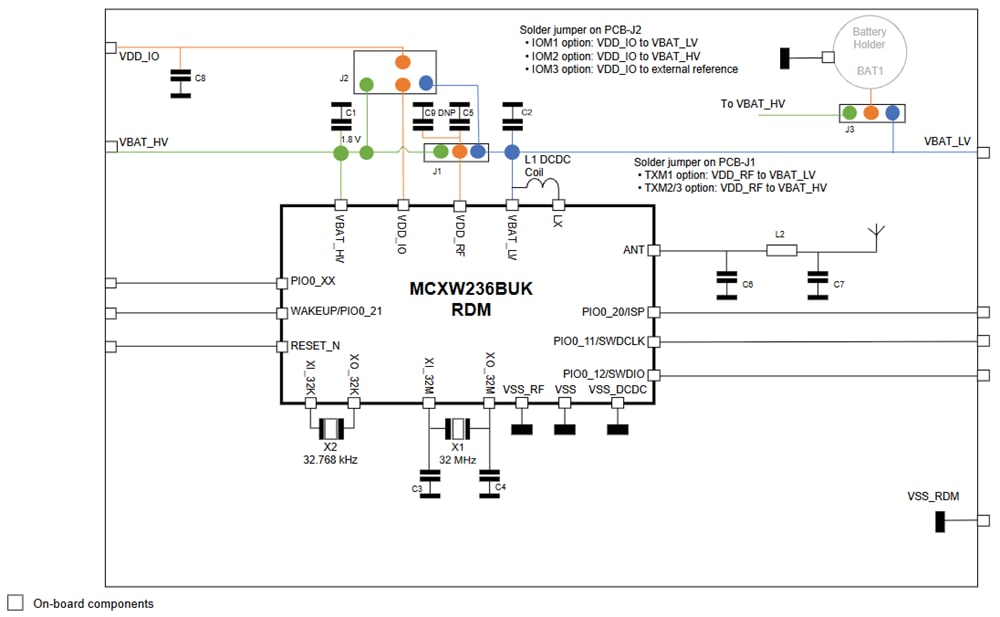
Block Diagram
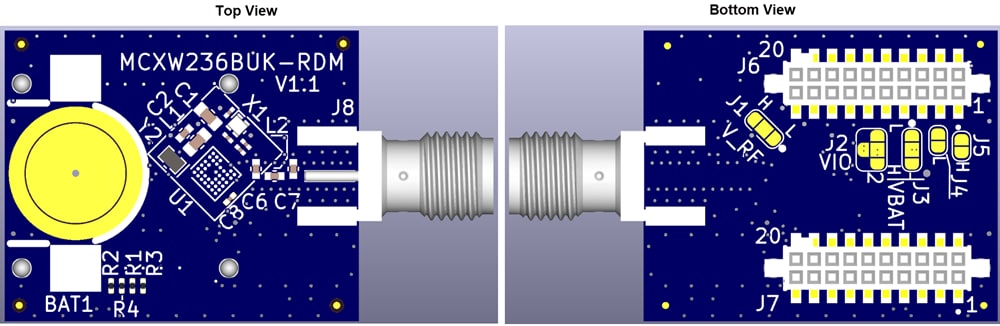
Board Layout
Related Wireless Microcontrollers

NXP Semiconductors Microcontrôleurs sans fil MCX W23
Émetteur-récepteur hautement intégré, mono-puce, sans fil Bluetooth basse consommation (BLE) avec microcontrôleur intégré et Flash.,
Publié le: 2026-02-18
| Mis à jour le: 2026-02-23