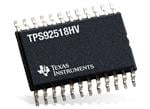

TPS92518HVPWPR

Texas Instruments
595-TPS92518HVPWPR
TPS92518HVPWPR

Fab. :

Description :
CI de pilotes d’éclairage par LED 65-V dual buck LED c ontroller with SPI A 595-TPS92518HVPWPT

Modèle de ECAO:
Téléchargez gratuitement le chargeur de bibliothèque pour convertir ce fichier pour votre outil ECAD. En savoir plus sur le modèle ECAD.

En stock: 1.169

Stock:
1.169 Expédition possible immédiatement
Délai usine :
18 Semaines Délai de production estimé en usine pour des quantités supérieures à celles indiquées.
Minimum : 1   Multiples : 1
Prix unitaire:
-,-- €
Ext. Prix:
-,-- €
Tarif est.:
Conditionnement:
Bobine complète(s) (commandez en multiples de 2000)

Prix (EUR)

Qté. Prix unitaire
Ext. Prix
Ruban à découper / MouseReel™
2,92 € 2,92 €
2,19 € 21,90 €
2,00 € 50,00 €
1,81 € 181,00 €
1,71 € 427,50 €
1,63 € 815,00 €
1,54 € 1.540,00 €
Bobine complète(s) (commandez en multiples de 2000)
1,48 € 2.960,00 €
1,44 € 5.760,00 €
† Les frais pour 5,00 € MouseReel™ seront calculés et ajoutés à votre panier. Les commandes MouseReel™ ne peuvent être ni annulées ni retournées.

Autre conditionnement

Fab. Numéro de référence:
Conditionnement:
Reel, Cut Tape, MouseReel
Disponibilité:
En stock
Prix:
3,26 €
Min.:
1

Produit similaire

Texas Instruments TPS92518HVPWPT
Texas Instruments
CI de pilotes d’éclairage par LED 65-V dual buck LED c ontroller with SPI A 595-TPS92518HVPWPR

Attribut de produit Valeur d'attribut Sélectionner l'attribut
Texas Instruments
Catégorie du produit: CI de pilotes d’éclairage par LED
RoHS:  
2 Output
Buck
5 A
HTSSOP-24
65 V
6.5 V
2 MHz
Adjustable
TPS92518HV
- 40 C
+ 125 C
Brightness Control/Dimming, High Output Accuracy, Thermal Shutdown
Reel
Cut Tape
MouseReel
Marque: Texas Instruments
Kit de développement: TPS92518EVM-878
Atténuation de lumière: Analog, PWM
Tension d'entrée: 6.5 V to 65 V
Sensibles à l’humidité: Yes
Style de montage: SMD/SMT
Nombre de canaux: 2 Channel
Produit: LED Controllers
Type de produit: LED Lighting Drivers
Nombre de pièces de l'usine: 2000
Sous-catégorie: Driver ICs
Courant d’alimentation maximal: 4 mA
Type: Controller Inductive
Poids de l''unité: 154,500 mg
Produits trouvés:
Pour consulter des produits similaires, sélectionnez au moins une case.
Sélectionnez au moins une case pour consulter des produits similaires dans cette catégorie.
Attributs sélectionnés: 0

Cette fonctionnalité nécessite l'activation de JavaScript.

TARIC:
8542399000
CNHTS:
8542399000
CAHTS:
8542310000
USHTS:
8542310030
MXHTS:
8542399901
ECCN:
EAR99

IS32LT3175N/P Single-Channel Linear LED Drivers

ISSI IS32LT3175N/P Single-Channel Linear LED Drivers come with fade in/out and PWM dimming. The regulators serve as a stand-alone LED driver-configurable from 20mA to 150mA with external resistors, no microcontroller is necessary. A logic level “courtesy light” signal from the PWM pin can be interfaced to precisely drive the LED channel. The IS32LT3175P obtains a positive polarity PWM signal. In addition, the IS32LT3175N obtains a negative polarity PWM signal. The regulator integrates a 63-step fade-in and fades out the algorithm (Gamma correction). This causes the output LED current to increasingly rise up to the full source value after the EN pin is pulsed.

TPS92518HV Dual Buck LED Controllers

Texas Instruments TPS92518HV Dual Buck LED Controllers with SPI Interface, Analog and PWM Dimming are ideal for multichannel and platform lighting driver module (LDM) applications. The TPS92518HV LED Controllers apply a high-voltage option with an input range of up to 65V. A quasi-hysteretic control method in the Texas Instruments TPS92518HV supports switching frequencies ranging from 1kHz to 2MHz, enabling superior, high-frequency shunt FET dimming. Additionally, the control method handles demanding dynamic loads of adaptive LED matrix-based headlamp systems. Software programmable SPI set points such as Precision Peak Current, Controlled Off-Time, and Output Voltage Sense Software allow designers to develop a single LED driver solution for multiple load configurations. These SPI set points can be rapidly reconfigured for future LED driver design requirements.